The garden comes inside….
A contemporary art journey inspired by the historic garden at Bolwick Hall, Norfolk.
Part of Norfolk and Norwich Festival from 10 May to 24 May, then by appointment and open for special events until August 2026
This spring and summer Caroline Fisher Projects returns to Norfolk with an exhibition entitled The Garden Comes Inside. A presentation at Collect at Somerset House was a taster for a larger exhibition in Norfolk from May to September 2026, highlighting contemporary art and making in relation to the garden at Bolwick Hall, Norfolk. This historic garden was designed by Humphry Repton and features cultivated and wilder areas of planting, a lake, the site of an old mill, marshland and woodland.
There are three major themes of the show: plants, animals and the land with ceramic work by: Hiroko Aono-Billson, Sarah Horlock, Aliyah Hussain, Helena Lacy, Tamlin Lundberg, Stephen Parry, Katherine Pleydell-Bouverie, Matthew Richardson, Katie Spragg, Nessie Stonebridge, Emily Stapleton Jefferis, Alice Walton, Lucy Whitford, and painting, print, textiles and photography by Vija Celmins, Lizzie Kimbley, Yayoi Kusama, Alida Kuzemczak-Sayer, Chloe Mandy and Kiki Smith.
Much of the work is being made to relate to the location including two mini-residencies with Katie Spragg @katie_spragg_ceram and Nessie Stonebridge @nessiestonebridge.
For all enquiries and prices please email: hello@carolinefisherprojects.org
Book tickets here: https://nnfestival.org.uk/whats-on/the-gardens-comes-inside/
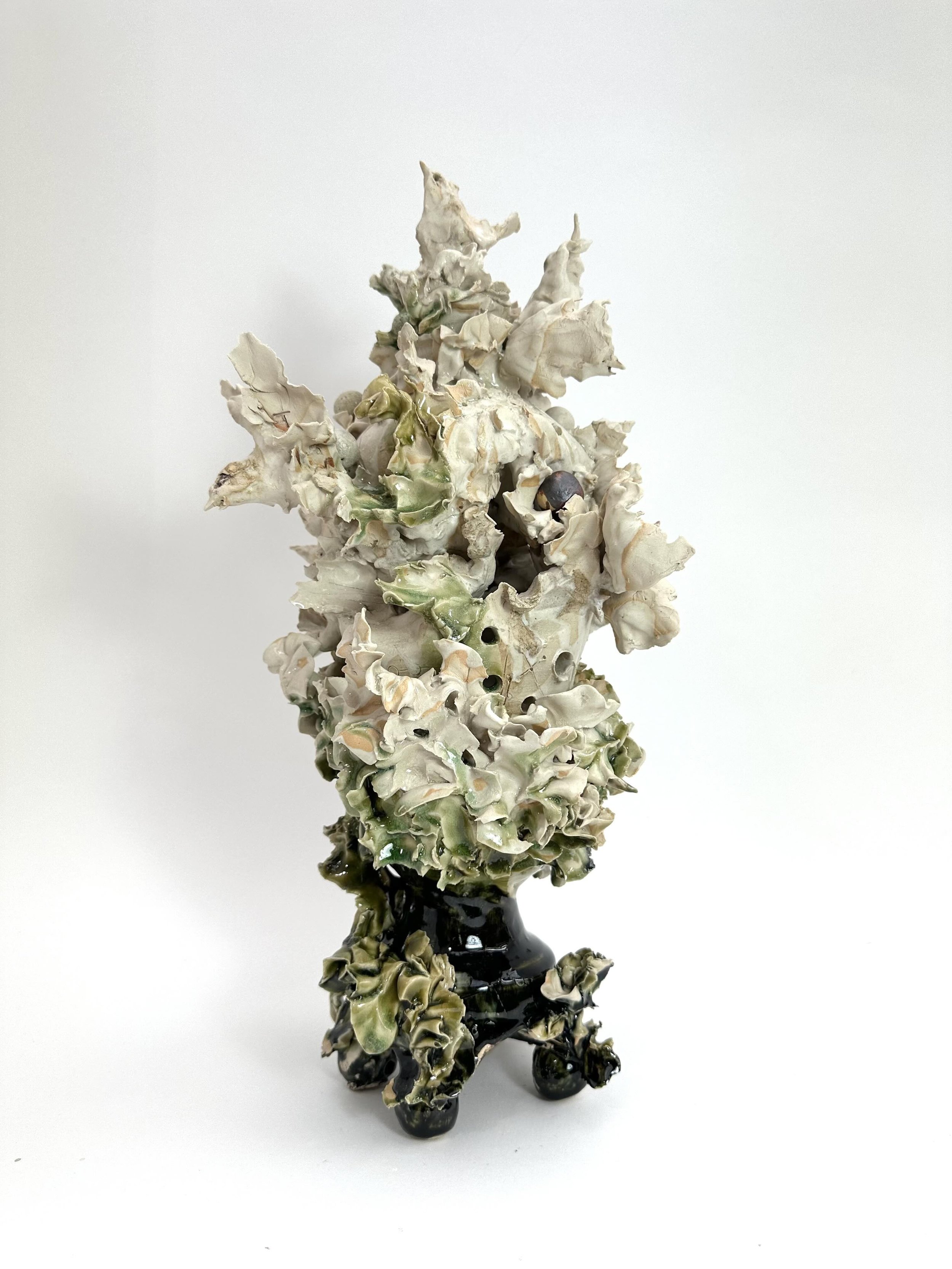
Nessie Stonebridge, Birdurn 5 songbirds, stoneware, 2025
For enquiries email hello@carolinefisherprojects.org
Artists at Collect 2026:
Helena Lacy
Helena Lacy is a London-based ceramic artist working across sculpture and sculptural furniture. Her practice explores material transformation, home, memory and storytelling, with pattern playing a central role.
She is inspired by patterns formed through natural movement as well as those embedded in print, using experimental draped glazing and printing techniques to balance structure with unpredictability. An ongoing influence in her work is an interest in found objects and ceramic fragments. Broken pottery shards are understood as traces of lived experience, carrying layered stories of ownership, place, and imagery. This way of reading objects as accumulations of multiple narratives informs her approach to pattern, distortion, and meaning.
These ideas are central to Re-print, a series examining how ceramic surfaces preserve and obscure storytelling. Originating from observations of image distortion in water reflections - understood as a form of living, unstable print - the work translates fluid imagery into fixed ceramic forms. Using a glaze-printing method developed during her MA at the Royal College of Art, Helena layers and reinterprets classical blue and white porcelain imagery. Through repetition, layering and image distortion, familiar motifs fragment and overlap, reflecting how stories are remembered and retold, and inviting reflection on the quiet power of material storytelling.
Stephen Parry
Stephen Parry has lived and worked in North Norfolk since 1981, when he set up Ryburgh Pottery.
His work is thrown and hand built, using high temperature stoneware and porcelain clays. The work is made in small batches focusing on a particular shape, while at the same time allowing each piece to subtly change during the first day or two of making.
Some pots are left unglazed, allowing the wood ash that enters the kiln during the long firing to glaze and colour the work. Other pots are glazed using wood ash glazes from the garden, including oak, apple and pine ash. Stephen’s home and studio are heated by local wood, so ash is a plentiful and renewable commodity.
The work is fired in one of several wood fired kilns that Stephen has access to, sometimes firing to well over 1300C for up to four days. A wood fired kiln has zones within it where the flames hit the pots in a similar way, creating a natural communication between the pieces in that area. Stephen is inspired by how this allows the pots to interact with each other, sometimes in pairs but more often in larger groups, bringing this flame created interaction out of the kiln.
Emily Stapleton Jefferis
Emily works between drawing and making, with a particular focus on the use of ceramics. Her sculptural work primarily involves clay, its plasticity, tactility and intimacy within our daily lives informing the alchemical processes by which clay becomes ceramics.
“Along with the human body I look to inspiration from the botanical and geological, zooming in on the overlooked or unseen, extracting the wonder, beauty and strangeness that exists just out of sight. I investigate the relationships between the microscopic and macroscopic, drawing on the real landscapes around us and the science-fiction worlds existing within our imaginations. My work is simultaneously familiar and alien.”
At Collect, a group of works relating to Emily’s fascination with lichen will be on show, all four have titles that originate from specific types of lichen, the mysterious life forms that are a symbiosis between fungi and bacteria.
Emily Stapleton Jefferis graduated in 2018 with an MA in Ceramics and Glass from The Royal College of Art, where she was awarded The Griffin Scholarship and The Eduardo Paolozzi Travel Award. Since graduating Emily has been developing her sculptural practice focusing on ceramics, and her socially engaged practice where she works across many mediums with a wide range of people. She is currently artist in residency at the V&A.
Nessie Stonebridge
Nessie Stonebridge’s ceramic sculpture is an expressive exploration of the relationship between predator and prey. The work takes shape in and around Stonebridge’s home, a farm in the rural centre of Norfolk, where the marshy landscape conceals the tension between birds and mammals constantly in a struggle with one another for survival.
Working between ceramic sculpture and oil painting, Nessie Stonebridge’s work is an expressive exploration of the relationship between predator and prey.
Much of Stonebridge’s practice emerges from the land itself. She takes daily walks through the surrounding countryside, making observations that inspire her paintings and sculptures. Her animals seem to leap out from the work, propelled by an urgency that speaks to life lived on the edge.
At Collect there will be four sculptural works on show, all demonstrating that nature is not pastoral, but fierce, fragile, and ferociously alive, with beauty and brutality entwined in every stroke.
Nessie Stonebridge graduated from the City and Guilds School of Art and has since worked between painting and sculpture, exhibiting widely across the UK, including Wolterton Hall, Norfolk in summer 2025 and currently, ‘In Proximity’ at Norwich Castle Museum.
Alice Walton
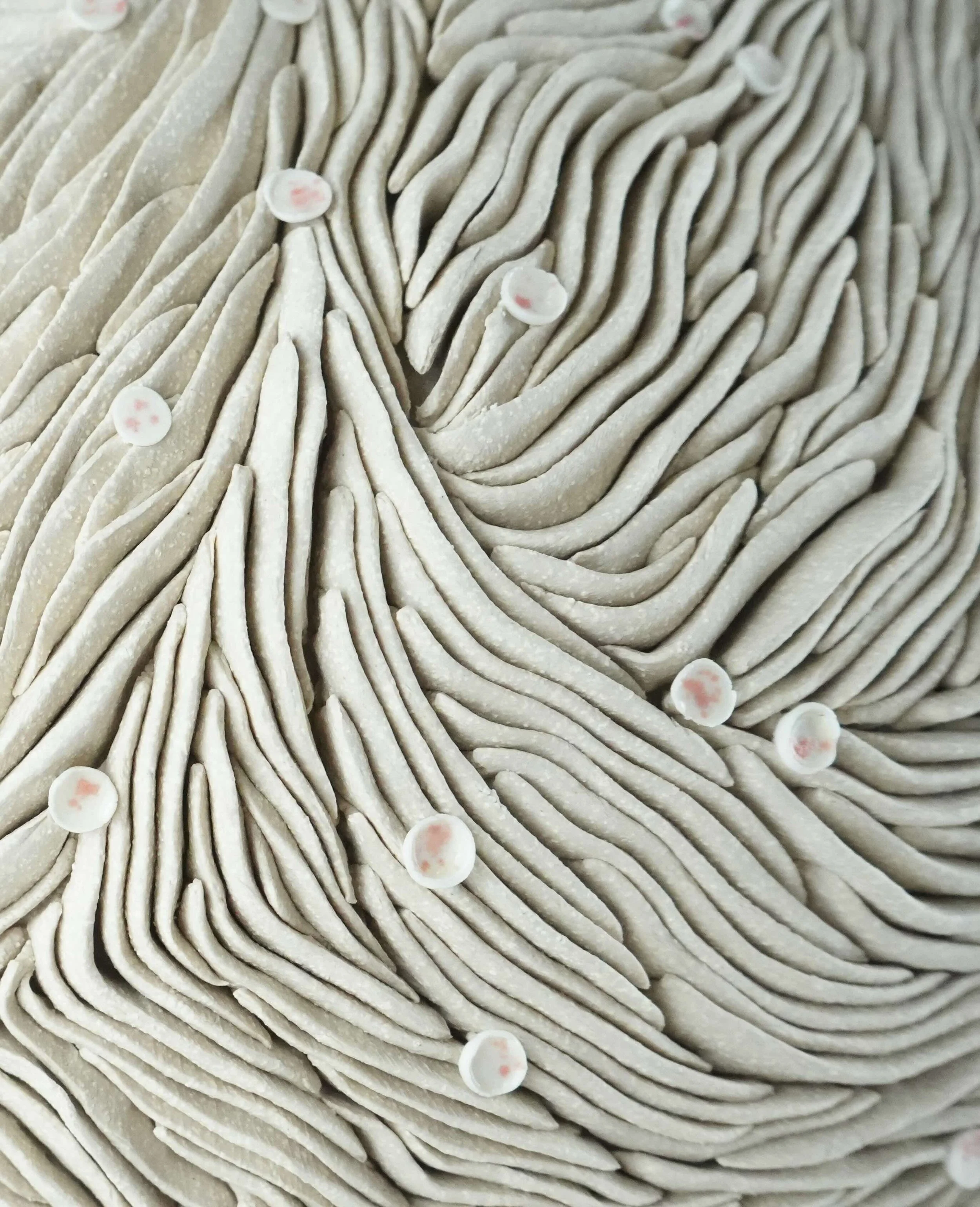
Alice Walton brings a new collection of four works to Collect, exploring the movement of gathered leaf eddies and speckling of natural lichens such as Cladonia. Colour is muted and reduced, to allow for the viewer’s focus to be on the changing light and shadows across the translucent contour lines. Walton looks at the connection between her local rural surroundings, mapped routes and natural patternation found unexpectedly. New movement, mark making and colour bleedings are chartered over the surfaces. Three of the four works focus on autumnal leaves: Abscission, Leaf Fall and Leaf Eddy document the moments when leaves break away from the tree, as they fall and the swirling of leaves as they settle, their colours against a white autumnal sky are minutely observed in porcelain.
Alice gained her MA in Ceramics from the Royal College of Art in 2018. Her unique, abstract ceramics have exhibited worldwide; including the Victoria and Albert Museum, Tate Modern, Make Hauser & Wirth, Officine Saffi, Collect 2020 and was awarded the Wedgewood Prize at the British Ceramics Biennial in 2019.
Lucy Whitford
Lucy Whitford is a London-based artist working in ceramics and sculptural installation.
Lucy’s practice centres on hand-built, coiled vessels and sculptural forms informed by personal narratives, mythologies, and rituals connected to the body, the home, and the natural world.
Caroline Fisher Projects is showing two works by Lucy at Collect.
Hollyhock Pot II is a coiled and hand-sculpted stoneware vessel made from finely textured black clay. These ideas emerge through the relationship between the vessel form and the hollyhock spires that rise from it.
“The hollyhock holds personal significance for me and appears throughout my practice. I am drawn to its sculptural form: a tall stem that carries bud, open flower, fading bloom, and seed head all at once. It embodies multiple stages of becoming, simultaneously.
The light-absorbing surface of the clay creates depth and quiet, inviting ambiguity and offering space for viewers to form their own connections with the piece - its materiality, its symbolism, and the visible traces of its making.”
Silueta III is a coiled and hand-sculpted stoneware vessel made from grogged white clay. The sculpted leaves turn toward and away from one another in undulating gestures, creating moments of tension and connection. The surface remains unglazed and exposed, emphasising the materiality of the clay. Marks, joins, and subtle variations in tone record time and process, making visible the act of coiling and shaping by hand.
Lucy graduated with an MA in Fine Art (Distinction) from Chelsea College of Arts in 2012 and has since exhibited in the UK and internationally in solo and group exhibitions. Her work is held in a number of prestigious private collections.
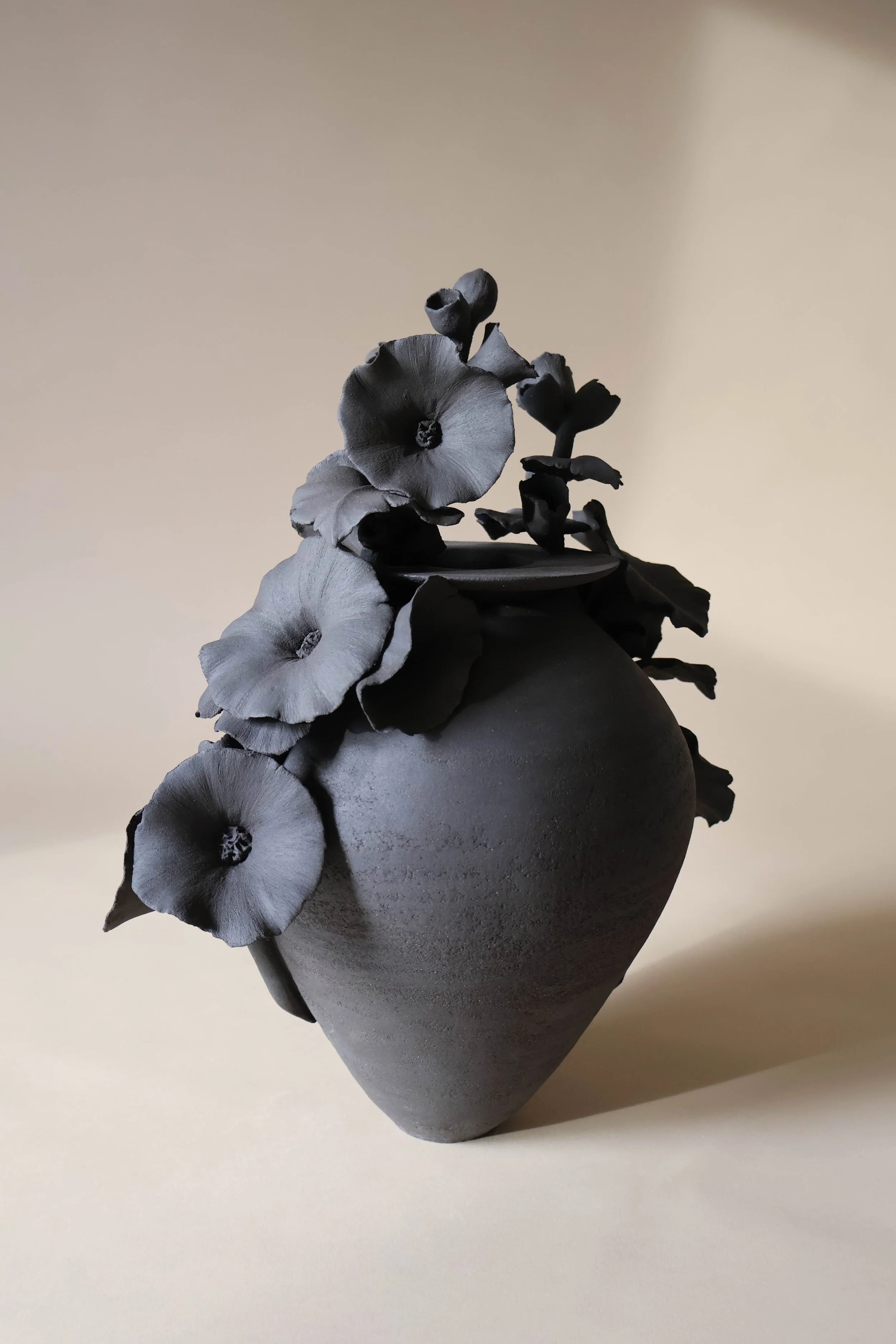
Lucy Whitford, Hollyhock pot, black stoneware, 2025